Hugo finalist ages
I think it was sometime last year that I saw someone on social media complain about their perception of the ages of the Hugo finalists.
I don’t remember exactly what they were unhappy about, but I think I remember that it wasn’t based on data, it was just their assumptions.
Which got me curious about the ages of Hugo finalists over time.
(Important note: I’m not making any value judgments about this data. This post is descriptive, not prescriptive; I don’t have a problem with any given finalist being any given age. I think it’s cool that there are relatively young finalists, relatively old finalists, and finalists at plenty of ages in between.)
Ever since then, I’ve been meaning to put together some data about this, and now I’ve finally done it, using data from the ISFDB. But I looked only at the four fiction categories that come first in the list of categories: Novel, Novella, Novelette, and Short Story.
While I was working on gathering that data, I found out that the ISFDB includes a field called debut_year, so I decided to also look at the number of years since each finalist’s first publication. (…Though I’m a little fuzzy on how the debut_year field is populated; I can’t find anything in the ISFDB documentation about it.)
Results
Ages
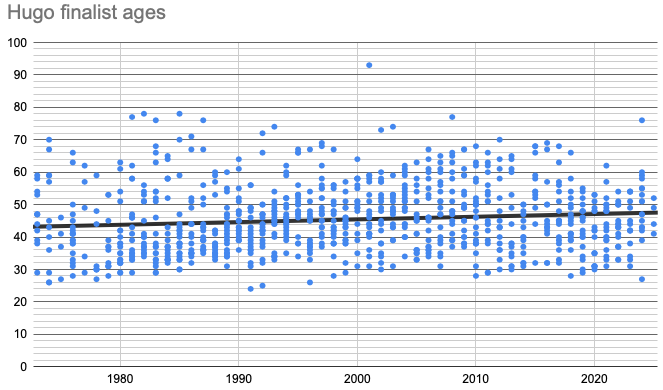
The average age of Hugo finalists in all of these fiction categories put together, from 1973 through 2025, is about 45.
The age trendline shows a slight increase over time, but not much of one.
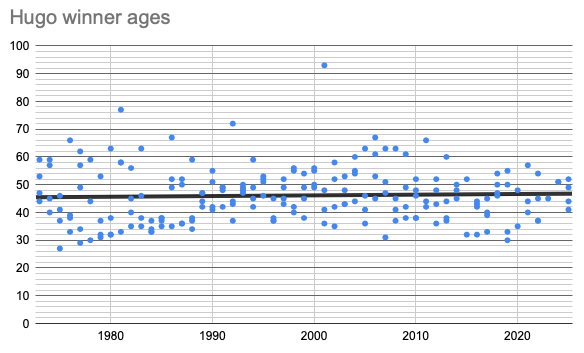
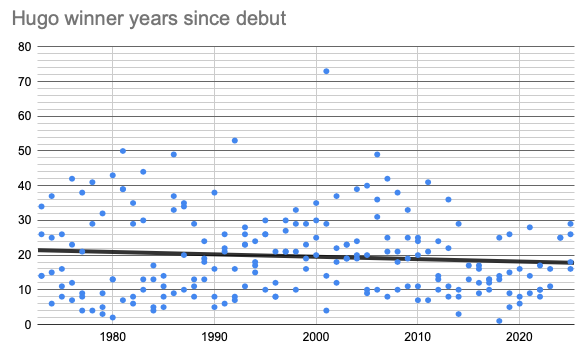
I also looked at only Hugo winners (across all of these categories together), and found pretty similar results.
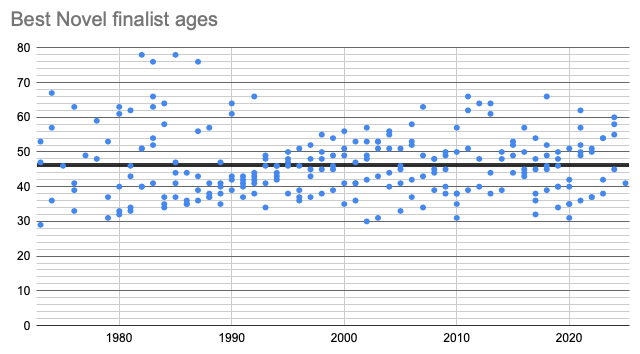
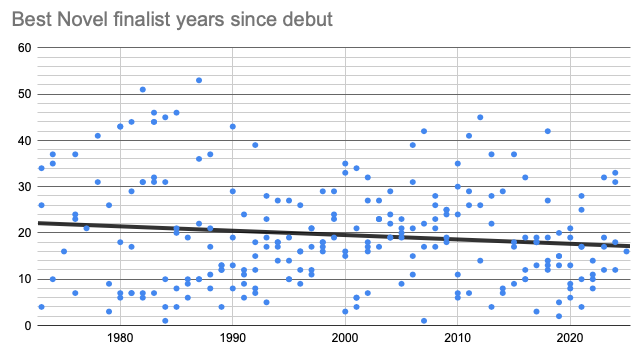
I also looked at finalists in only the Best Novel category, and found pretty similar results.
Years since debut
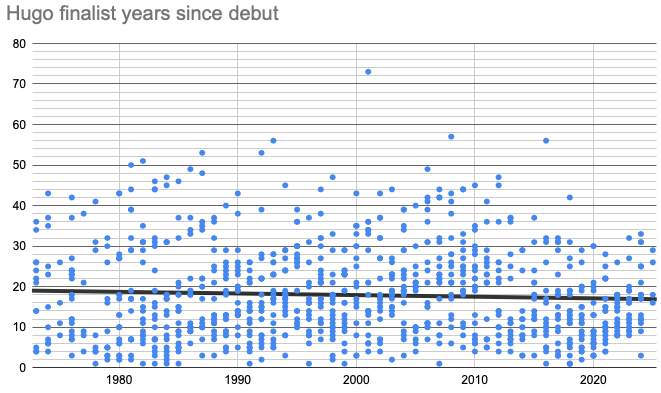
The average years-since-debut is about 18; which is to say, most authors have pretty well-established careers before they get nominated. But by no means all; for example, there’ve been about a dozen authors who’ve been finalists within a year or so after their debuts.
The years-since-debut trendline shows a slight decrease over time, but again not by much.
The winners-across-all-categories and Best-Novel-finalists graphs are pretty similar:
Notes
In the all-finalists ages chart, there appear to be some diagonal lines of dots, increasing over time. In some cases, those are just coincidental, but in at least one case, it’s the same author: Mike Resnick had at least one work on the ballot in most years from 1989 through 2012, and the diagonal line of dots across those years shows his age increasing at the usual rate of one year older per year passing.
There are lots of other ways this data could be analyzed. For example, I looked at Best Novel alone, but not at the other categories. And I looked at winners across all categories, but not at winners in individual categories.
Two interesting data points:
- I think Ted Chiang is the only author who’s been a finalist before turning 25. (But I don’t know what time of year Ted’s birthday is; for more about specific birthdays, see the Methodology section.)
- Jack Williamson was by far the oldest finalist, at age 93 in 2001. (The next-oldest finalists were several authors in their late 70s.)
Data
If any of you want to do anything with the data I’ve extracted, feel free to copy the spreadsheet. (It has three tabs: one for all categories, one for Best Novel finalists, and one for winners.)
But note the methodology-flaws section below.
Methodology
I downloaded a copy of the ISFDB database, and loaded it into a MySQL database on my computer. Then I wrote some Python code that extracted the data I was looking for; then I copied and pasted that data into a Google Sheets spreadsheet, and created graphs in Google Sheets.
Some flaws in my methodology
- I only compared/subtracted years; I didn’t look at when in the year a finalist’s birthday was, nor at when in each year the Hugo finalists were announced. So for some finalists, the age-at-time-of-being-a-finalist in my data is off by a year. But I’m more interested in general trends and averages than in details of specific authors’ precise ages, so I didn’t bother trying to correct for this.
- ISFDB is missing birth years for some authors (including about a dozen of y’all who might be reading this), and missing debut years for some others. I suspect that on average, the authors for whom it’s missing data are probably a little younger and/or earlier in their careers than the authors for whom it has data; but there’s enough data that even if all of the missing-data authors are improbably young, it wouldn’t reduce the overall average too much.
- For various reasons, years before 1973 weren’t as easy to collect consistent-with-later-years data from, so I started with 1973.
- There’s some missing data for 1975, due to the way the non-winning finalists for that year are labeled in ISFDB. There may be similarly missing data in other years.
- For 2025, the non-winning finalists aren’t yet included, because the detailed stats haven’t yet been released. (So ISFDB currently has the non-winning finalists labeled in a way that my database query doesn’t pick up.) I could write code to work around this, but presumably those finalists will get relabeled when the detailed stats are released, so I’ll just wait for that. In the meantime, I doubt that the missing 20 or so data points for 2025 make a big difference in the overall results.
- I haven’t yet addressed some edge cases, such as works that have more than one author (which are currently just not included in my data).